Gunpoint turns the classic heist movie into a deceptively deep puzzle box, and it does so with a handful of side-on buildings, a scrappy crew of burglars and a lovingly retro future. If you enjoy patient, plan-driven games where the solution is always sitting two seconds ahead of you, this is an easy recommendation. It is short, sharp and endlessly replayable, making it a perfect pick for anyone who wants a complete story in a single evening rather than a hundred-hour commitment.
About Gunpoint
Gunpoint is a stealth puzzle-platform game created by indie developer Tom Francis and released by his studio Suspicious Developments in 2013. Francis built the first version in his spare time while working as a section editor at PC Gamer UK magazine, learning Game Maker 8 as he went, and the total development cost is reported to have been about thirty dollars. It launched on Windows on 3 June 2013, with Linux and OS X versions following in September 2014 through a Humble Bundle, and it sits at a permanently low price of roughly ten dollars on Steam today.
You play Richard Conway, a freelance spy framed for the murder of a weapons manufacturer, working through a noir-inspired story of espionage and murder over more than twenty missions. Conway takes jobs from clients through a PDA-style menu, buys new gear between contracts and doles out ability points, while two sidekicks, a veteran burglar and a sharp-tongued technical expert, keep the banter running. Every mission is a handcrafted diorama, and no two play the same way.
Gameplay & Features
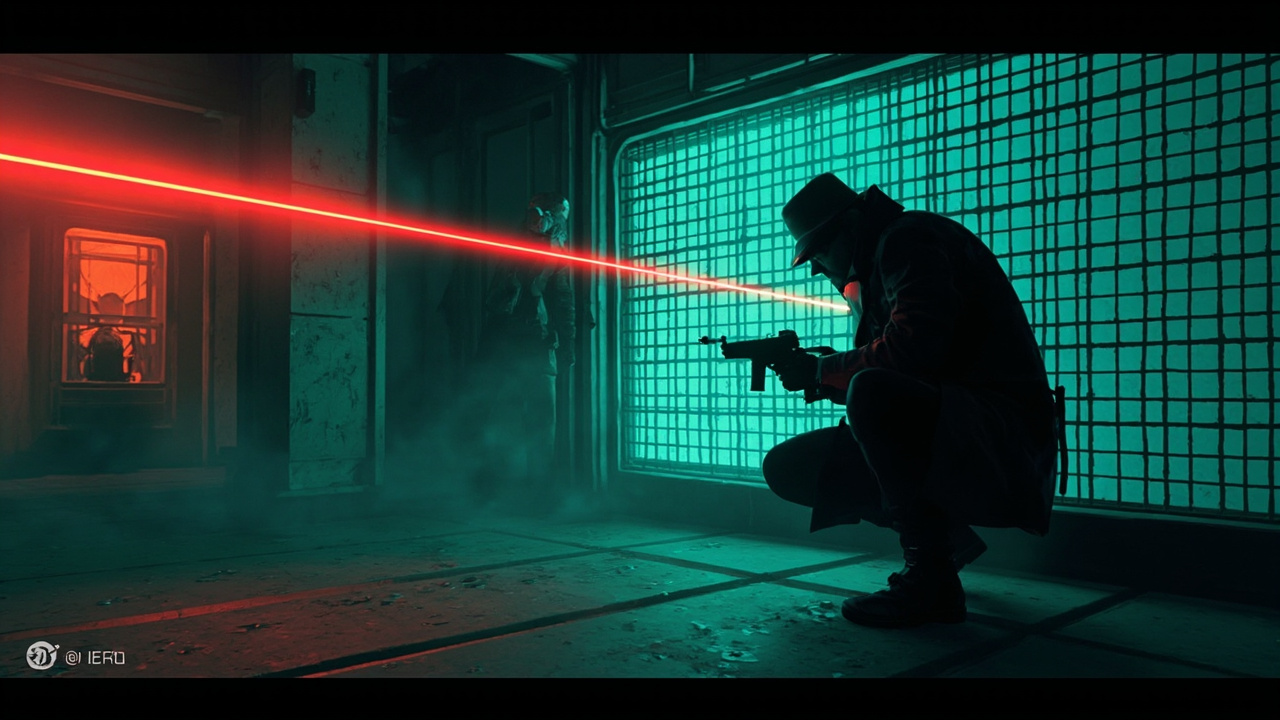
At its core, Gunpoint is about information and routing. Each building is shown in a two-dimensional cross-section, with guards, doors, light switches, cameras, turrets and objectives all visible at once. Conway can run, climb walls, use stairwells and elevators, and launch himself great distances with his Bullfrog hypertrousers, smashing through plate glass when it suits him. A single gunshot kills you instantly, so guards are treated as genuine threats rather than damage sponges, and there are no boss fights to grind through.
The star of the show is the Crosslink, a device that reveals how every device in the level is wired together and lets you rewire it with the mouse. Connect a light switch to a secured door and flick it as a guard walks past, and you have just turned the building’s own security against its staff. Later gadgets widen the vocabulary considerably. The Wirejack handles secured circuits, Longshot lets you rewire the guns your enemies carry, Prankspam drops electrical traps that stun a patrol, Dropshot softens your landings so guards never hear you arrive, Deathfluke gives you a chance to dodge incoming fire, and Gatecrashers turns locked doors into something you simply kick open.
Because the toolkit keeps expanding while the level layouts keep rearranging, familiar mechanics never go stale. A simple trick that solves the second mission can be the only viable route through the twentieth, when the target is sealed behind a shaft nobody else would think to try.
What keeps the core loop fresh long after the campaign ends is the built-in level editor, which lets you design your own buildings and share them through Steam Workshop. Support for user-made levels arrived with the engine update, so the community has had years to publish missions that the original campaign never had room for. Each completed mission is also scored on the time taken, the number of guards taken out, how many times you were spotted and how much noise you made, which gives you a clean reason to go back and improve a route you already solved the lazy way.
Presentation deserves a special mention. The clean line art and flat noir palette make every building read instantly, and the electronic score shifts with the tension of the moment. The result feels surprisingly atmospheric for something this small, and the writing lands every joke without ever getting in the way of the puzzle.
Pros & Cons
Pros
- Exceptionally smart level design that keeps teaching new ideas while reusing familiar tools in clever ways.
- Cheap and complete at a very approachable price, with a full campaign and no DLC paywalls.
- Excellent score and mood that make a tiny stealth game feel surprisingly cinematic.
- Zero-fuss play that runs on virtually any modern PC and works on Linux and macOS as well as Windows.
- Replayability from the built-in level editor, Steam Workshop community missions and per-mission scoring.
- Smart, humorous writing that gives the cast real personality without ever getting in the way.
Cons
- Short campaign that most players will finish in a small number of sessions, which can feel brief at full price.
- Combat is intentionally clumsy by design, so players who want a shoot-’em-up will be disappointed.
- Some solutions are trial-and-error, and a few late levels demand precise timing that can feel punishing without a checkpoint nearby.
- Minimal replay storytelling means there is no branching narrative to explore after the credits.
- Not available on consoles, which limits who can play it on a living-room setup.
The Verdict
Gunpoint is a small game with a big idea: that stealth should be about outthinking the environment rather than outrunning the guard. Every mechanic is legible, every solution is satisfying, and the difficulty ramps with confidence instead of cheap tricks. It remains a fine recommendation in 2026 for players who enjoy cerebral action games, immersive-sim-lite stealth, or simply want one high-quality evening of play that respects their time.
If you want something longer, pair it with a narrative-driven adventure or a pure puzzler. If you want something grittier and more mechanical, look for a tactical shooter. But for tight, clever, retro-future burglary, Gunpoint is still the benchmark.
Visit the official Gunpoint website for more details